What do you do when your tried and true techniques don’t give the client relief? Or maybe your work does help but you just *know* you’re still missing something deeper and more important.
 Pain is a very complex phenomenon, with many causes and manifestations. And sometimes a client’s pain either doesn’t respond to our best efforts, or the whole picture just doesn’t seem “right”.
Sometimes it just doesn’t fit the patterns we’re used to seeing, even if we think we’ve seen them all!
The following story is an amalgam of two clients’ stories, with some details changed to protect anonymity.
Peter was a handsome, wealthy web designer with a very young look that made him seem almost child-like. He was 44 but he told me that people assumed he was in his early 20s. His soft looks and speaking voice contrasted remarkably with the authoritative way he spoke about what he needed from me, and his own professional work. It reminded me a little of the scene in the show “A Chorus Line” where the auditioners hold their headshots in front of their faces.
Peter had a successful professional singing career, in opera and on Broadway, before returning to design thr ee years ago. He presented with severe neck pain that was referring into his right arm and hand and interfering with sleep and work.
He came with MRIs showing a complete loss of cervical curvature, spinal stenosis, ossification of the anterior longitudinal ligament, and arthritis in his spine. He described a traumatic fall as a child, which resulted in long-term rest therapy, after which his neck was “never the same”.
His pain had taken a decided turn for the worse a few years earlier, at the time he was transitioning back to his career in web design.
Peter wasn’t weak, but he had a feeble look. His body, though not thin, “felt” thin as I looked at it… He had surprisingly low core strength and body lift for someone who was a stage performer.
From ribcage to hips, he looked kind of ‘empty’ in the front. He would’ve looked fine in a photograph, but looking at him in person, on the table, with his shirt off, the area from belly to his hips had a visual texture more like a cloud than a solid muscle/bone/organ structure. At the level of his tissues, it was like the phrase “the lights are on but nobody’s home” – a lack of presence.
I performed an orthopedic test on Peter’s neck, which was positive, meaning that his lower neck, when compressed, referred pain to his hands. I also found that the scalenes referred pain to his hand.
We were talking about his career history, and I was in the middle of trying to invent a simultaneous scalene release/traction maneuver for Peter, when I began to feel a bongo-like energy wave coming from his pelvis. Strange. I think I actually felt heat.
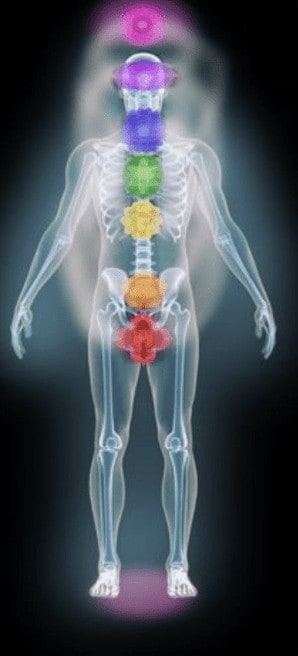 The pelvis is the seat of the first and second chakras. The first chakra has to do with grounding, earthiness, family of origin, ancestors, “roots” in every sense of the word. The second is associated with pleasure, creativity, created family, and sexuality, among other things.
Given his symptoms, I started thinking about the neck chakra as well.
The neck is the fifth chakra, the seat of reputation, identity, and self-esteem. It governs gesture and voice, in every sense of those terms. The fifth chakra also includes the neck, shoulders and arms. The throat chakra is about the action you take and don’t take in the world, your gestures and postures and words, how y9u show up for yourself and the world and how well you keep up your end of the deal.
My hands kept mobilizing Peter’s neck – gently – and I asked about his singing career — a creative, self-expressive endeavor that involves the throat.
Three years ago, Peter went to Asia for a professional singing gig. The director “turned out to be alcoholic and so crazy that she made my hair go on end”. His interactions with the director were so abusive that Peter lost his singing and speaking voice. He dropped out of the gig, came back to the States, and didn’t sing in public after that event.
Noticing unusual energetics in his first two chakras, I found myself wondering about his childhood, so I asked him about the history of his singing. He had begun professional singing at age 5, singing with folk choirs, first in Korea and later in Mexico. He was raised in an alcoholic home where there was “abuse of many kinds,” and music was a release and escape for him, “a safe place.” I inferred that some of the abuse may have been sexual, as he was unreserved about naming the alcoholism but was remarkably unspecific about the “many other kinds” of  abuse.
The treatment helped Peter’s arm. I moved to his abdomen/pelvis and paid a lot of attention to making/holding space while introducing healthy motion into the joints. As I was doing so and holding space in his lower two chakras, I asked if he would sing me a Korean folk song. To my surprise, he agreed to.
What a clear, bell-like voice Peter had, and how firm, full, and innocent his body became as he sang, a far cry from the empty energetic feel his body had when I started the treatment. It made me wonder how much better literally everyone would feel if they sang every day.
Peter and I worked together for some time, during which his “awful, horrible” neck pain became manageable and even sometimes minimal. I asked every time, and he was often willing to sing during the session.
I don’t know if Peter returned to professional singing, but I hope someone is getting to hear the beautiful song of his soul.
7-minute Shoulder Video
Got 7 minutes to look at this deeper-dive video that will explain your shoulder problem and give you strategies?
If you and/or someone you care for are having pain where the torso meets the arm – the “true shoulder” joint – this video will help you. It will explain the anatomy of “true shoulder” pain and give you a couple of easy ways to mobilize and strengthen for more ease and efficiency.
If you’re lucky and plucky, that will solve the problem. Healthy movement is the true healer.
But sometimes you just can’t get a joint to move in a healthy way without an adjustment/treatment. That’s why I’m here.
In that case, don’t force a solution and don’t ignore your problem. Instead, make an appointment right here. When you’re back on track – literally – the video will help you stay there.
https://www.youtube.com/watch?v=iM8NWIEX4Vw
Leave a Reply